Using our new LED UV Display Lamps, you can make a Glow Box without knowing anything about electronics, LEDs, etc.
It’s straight forward. You make the box and simply add either of our UV Lamps.
The Size of Your Box
Size is important. The further from the UV source a rock is, the less UV gets to the rock so it glows less brightly*. When our FSD Short Wave Lamp is placed about 40-45cm above rocks they glow well, even some weakly fluorescent ones. At a height of about 45cm, the area lit by FSD is about 30cm x 40cm, so you would make the base of your box about that size. You can increase the area lit by the lamp by increasing its height above the rocks, but the fluorescence will be less bright*. Experiment with your rocks as in the diagram below. If you make the base larger than the lit area for the height you are using, rocks outside the lit area won’t glow.
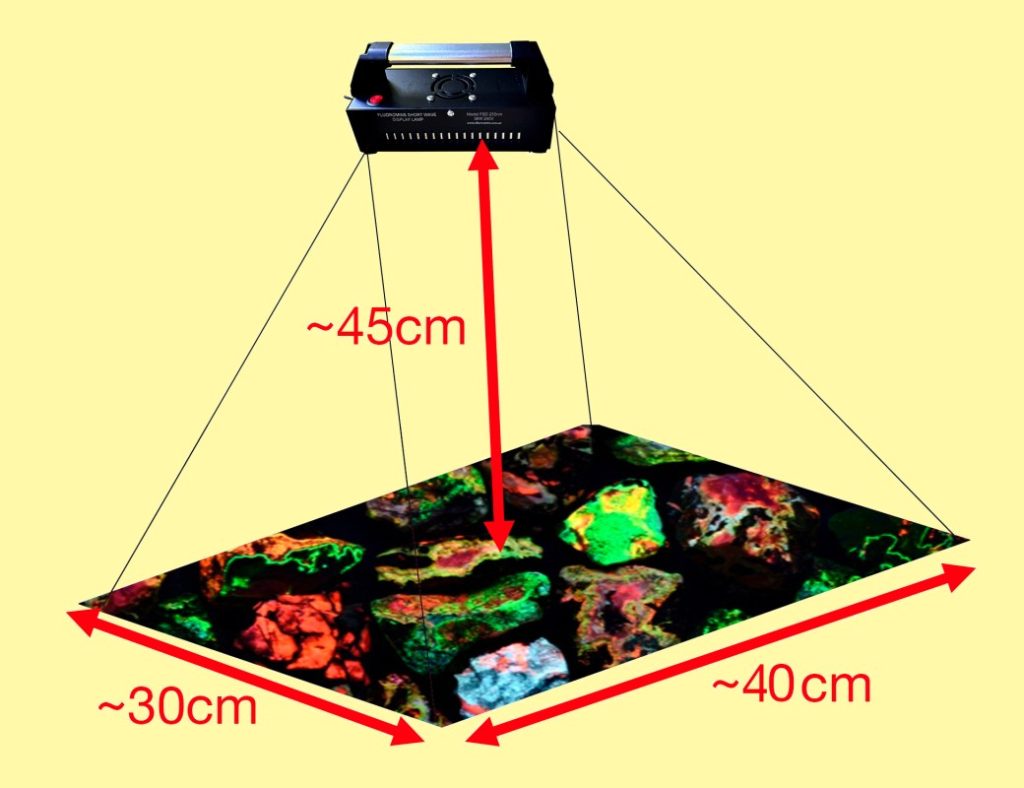
*[This is the “Inverse Square Law”. If you double the height, the amount of light reaching the rocks goes down by 4 times. If you triple the height the light reaching the rocks goes down by 9 times. 4 times the height, light is down by 16 times and so on.]
There’s another way to have a bigger glow box. You can double the length or depth, and use two UV lamps, while keeping the same height. So you might have a box 80(L) x 30(D) x 45(H) cm.
Making the Box
OK, you’ve decided on dimensions. For the example above you would make a box about 32 x 42 x 47cm (outside measurements). You can use ply or MDF. I have used 9mm marine ply. You need to make a box with two sides, back, top and bottom. No front – it will be the UV-blocking window.
You can get a ready made box!
If you can’t make a box, IKEA sell one that works very well as a 35x35x35cm UV display box. See below. https://www.ikea.com/au/en/p/eket-cabinet-brown-walnut-effect-40530578/#content. Use your browser’s back button to come back here.
UPDATE
I have found a better box: https://www.vidaxl.com.au/e/vidaxl-bedside-cabinets-2-pcs-35.5×33.5×41.5-cm-solid-pinewood/8720286772492.html . It is made from better material – genuine pine timber.
In the middle of the top you’ll cut a rectangular hole 95mm x 245mm (9.5cm x 24.5cm). The Lamp will sit in this hole. On the underside of the top you’ll put 4 small tabs (or something similar) to stop the Lamp falling through.
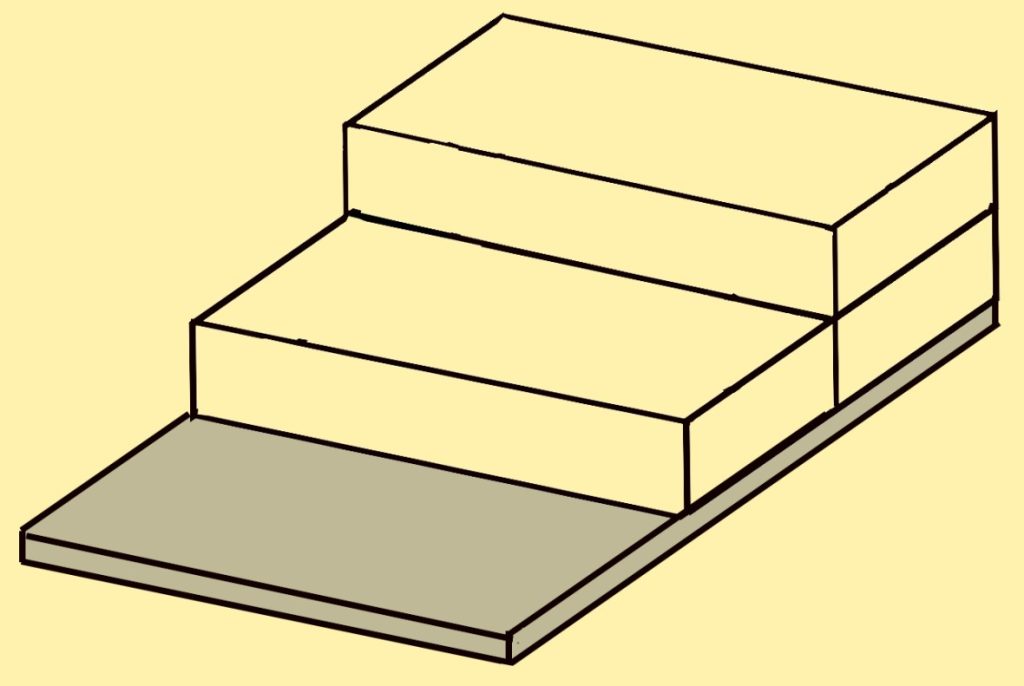
Most displays have steps to put the rocks on. How you make the steps is up to you, but a simple way is to use pieces of dressed timber. Two steps and the bottom (as shown) would be appropriate for the set-up above. Don’t try to use shelves, including glass ones. They block UV from getting to lower rocks.
The inside of the box and the steps should be painted with non-fluorescing flat black paint (e.g. Tradex). Using black fabric on the shelves looks nice to start wth, but the UV will soon degrade and discolour it.
The Safety Screen – The Front Window
There are various ways to fit the front window. One way is to glue or otherwise fix strips of timber (~10 x 5mm) right around the opening about 3-4mm in from the edge so the screen fits in nicely.
What to use, and what not to use for the front window:
Don’t use glass. Even though it blocks SW and MW (not LW), it is not suitable because it can fluoresce, and looking at your rocks through it is like looking at them through a bright fog.
Don’t use the rigid clear PVC sheets that Bunnings and similar places sell (about $40 at Bunnings). It fluoresces and looking at your rocks through it is like looking at them through a bright fog.
Ordinary perspex (acrylic sheet) is OK. It blocks almost all SW and MW UV but not LW UV. It is crystal clear and unbreakable. You can get it from Plastics Shops.
Crystal clear “table cloth” PVC, the stuff that is also used for flexible windows in tents, boats etc will block SW and MW (not LW), but it degrades after a while and has to be replaced. But it is relatively cheap and it works.
Fluorescence collectors use Acrylite OP2 (or OP3) or Plexiglass (trade names), thickness 3mm. These are museum grade products, used to protect valuable items from all UV wavelengths. They block >99% of SW, MW and LW. Museums use them to keep UV OUT. We use them to keep UV IN! They are, of course, more expensive, but all fluorescence collectors use them. A seller who may cut to size is here.
If you’ve made a SW display but you can’t work out how to do a safety window, you need to have UV blocking glasses available for any longer than short periods of viewing.
Placing Your Specimens
The strongest UV area is directly below the lamp. So that’s where your weakly fluorescing specimens go. The strongly fluorescing ones can go towards the edges.
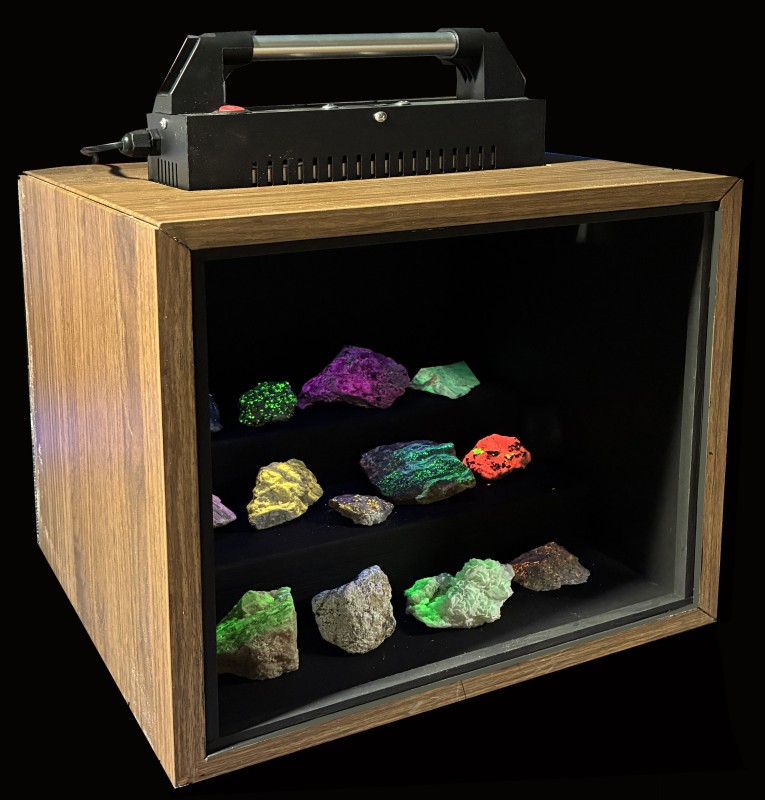
and our FSD Short Wave UV Lamp
If that all sounds too complicated…
You can set up a nice display without a box, and show it using a torch or a lamp. Just make some steps to put your specimens on. If you are showing them using a SW or MW torch or lamp you must point it towards the rocks, and definitely away from the viewers. LW is not such a problem. For longer viewing with SW and MW you should have a couple of pairs of UV-blocking glasses handy.
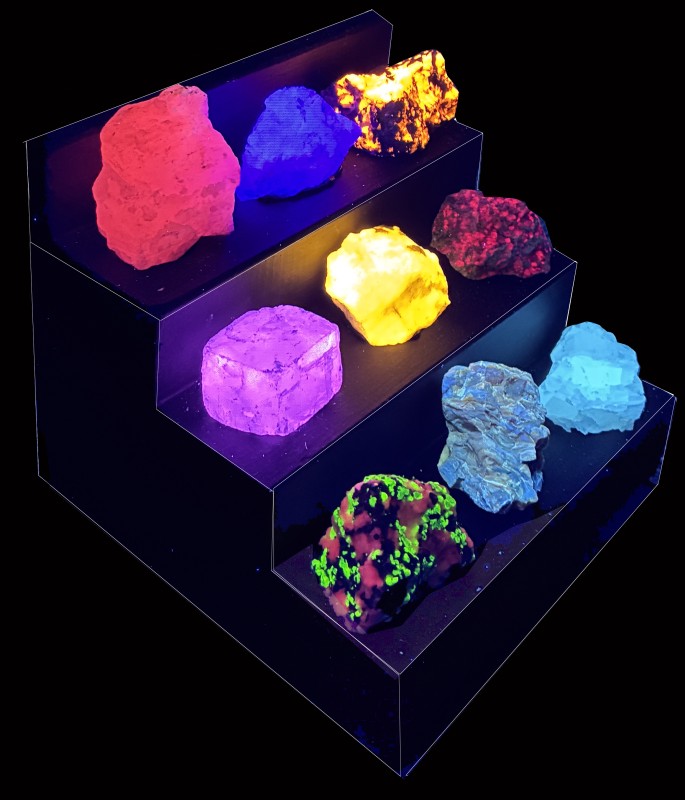
The price of our “Small Display Stand” (16cm x 15cm x 12cm height) as shown is $50. Price does not include rocks.
GO HOME