What are red, blue, yellow etc? They are colours of visible light.
In just the same way, Short Wave, Mid Wave, Long Wave are “colours” of ultraviolet light (UV), but we can’t see them. They are also known as UVC, UVB and UVA in that order.
The sun radiates all the colours of UV light as well as all the visible colours we can see.
Long Wave (UVA) is often seen in clubs, dance halls etc. It makes your clothes, fingernails, teeth glow (fluoresce)
Mid Wave (UVB) has more energy – it sunburns you. It was used in tanning beds. It has medical applications.
Short Wave (UVC) is more energetic still, but fortunately, the ozone layer blocks it from getting down to earth. UVC lamps are widely used for sterilisation and germicidal purposes.
They are all used to make fluorescent minerals glow.
Years ago UV could only be produced by tubes. Now it can be produced with LEDs.
You need to protect eyes and skin when using Short Wave or Mid Wave for any length of time. You should never look for more than a second into any turned-on UV lamp or torch. (See UV Safety)
Some rocks (minerals) glow under UV. Most don’t. Some rocks fluoresce (glow) under Short Wave, others under Mid Wave and others under Long Wave. Some glow under more than one UV wavelength. Whether a mineral glows depends on whether it absorbs rather than reflects UV light and also on what impurities (called “activators”) are present.
Some minerals fluoresce very differently under more than one wavelength. For example some willemite from Puttapa in South Australia glows bright green under SW and bright yellow under MW.
Ordinary fluorescent ceiling lights work like this: Inside the tube Short Wave UV is generated. The inside surface of the glass tube is coated with stuff (called phosphor) that the Short Wave UV causes to fluoresce bright white or whatever colour the fluorescent light is. That’s why they’re called fluorescent lights.
MORE ABOUT ULTRAVIOLET LIGHT
Ultra-violet means beyond violet. Go past Violet in the rainbow and you are into Ultraviolet. The further you go the shorter the wavelengths – See Fig 1. The wavelength is the distance between adjacent wave peaks. It is measured in nanometres (nm) which is a billionth of a metre or a millionth of a millimeter.
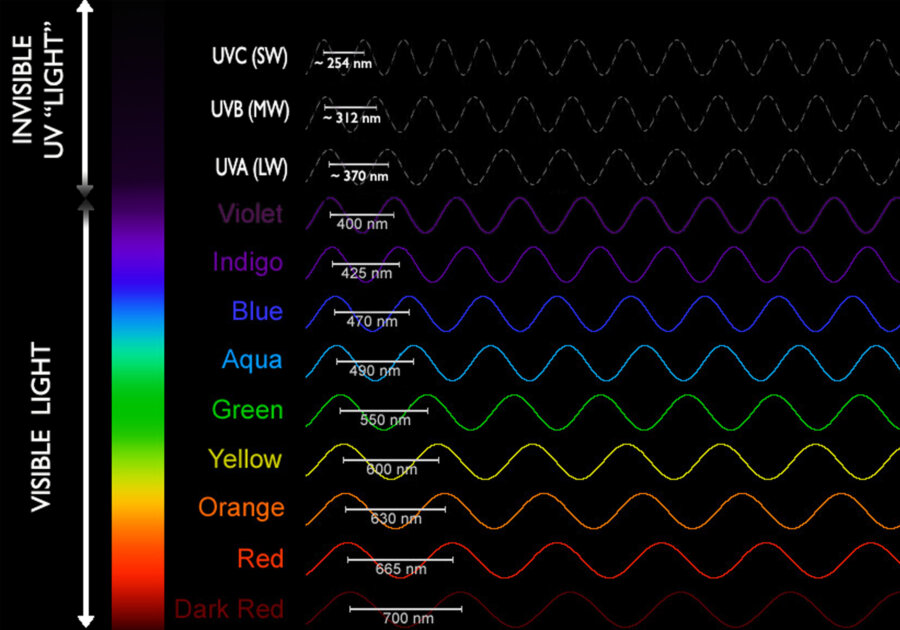
All UV light can cause fluorescence, but for convenience there are three wavelengths that are given names. UVA is Long Wave (~360-390nm), UVB is Mid Wave (~310nm), UVC is Short Wave (~255nm). UV Torches have now been made in these three wavelengths. However, LEDs are now being made in other wavelengths, and people are reporting interesting fluorescence under these new wavelengths, e.g. 275nm.
Long wave LEDs have been around for a long time. They can be made to be very bright. Mid and Short Wave LEDs are fairly new and are not yet very bright – but further research is making them brighter as time goes on. Getting them to make more light and less heat is part of the development problem.
Filters
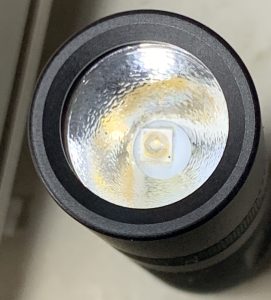
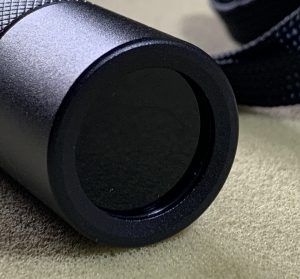
All UV LEDs make some visible light as well as UV light. The visible light distorts the fluorescence colours, so we have to block the visible light from coming out. That is what the filter does, sometimes called a Band Pass Filter. We only sell filtered torches. With the torch turned off, if you can see the LED(s) then there is no filter and the torch is useless for mineral fluorescence. A filtered torch has a black circle at the front end – and that is the filter. See Fig 2,3.