



All our UV torches have a filter. Why?
All UV LEDs produce visible light as well as UV light. Some UV LEDs make not much visible light, most make more. You’ve probably seen things under a coloured light (like green or red) – it changes the colour of everything. So a UV LED does two things: (1) Its UV light causes some things to fluoresce, (2) Its visible light changes the colour of things.
We want to see the fluorescence of a mineral under UV light. We don’t want to see the colour-changed rock. So we need to block the visible light from coming out of the UV torch. That’s what the torch light filter does and that’s why it’s needed. Such filters are called “band pass filters”.
IMPORTANT
The filter blocks visible light, not UV. So you need to be aware of safety requirements when using ultraviolet lights.
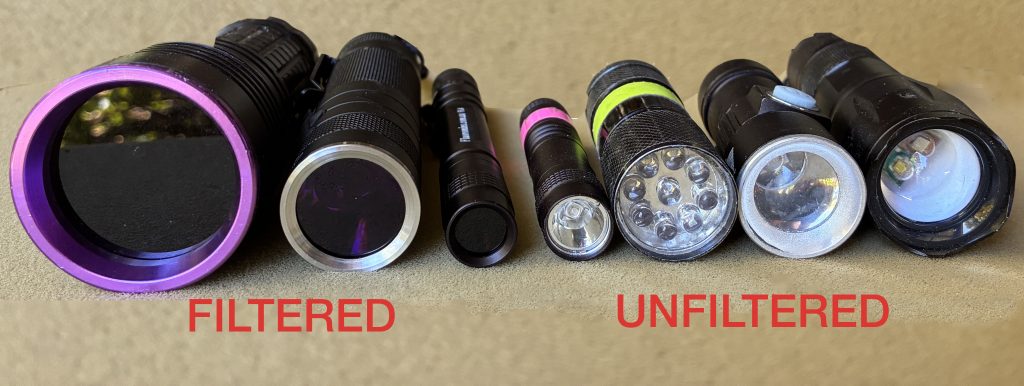
The filter on the UV torch looks like a black circle at the front of the torch. If there is no black circle and you can see the LED(s) then the UV torch has no filter and both UV and visible light will come out.
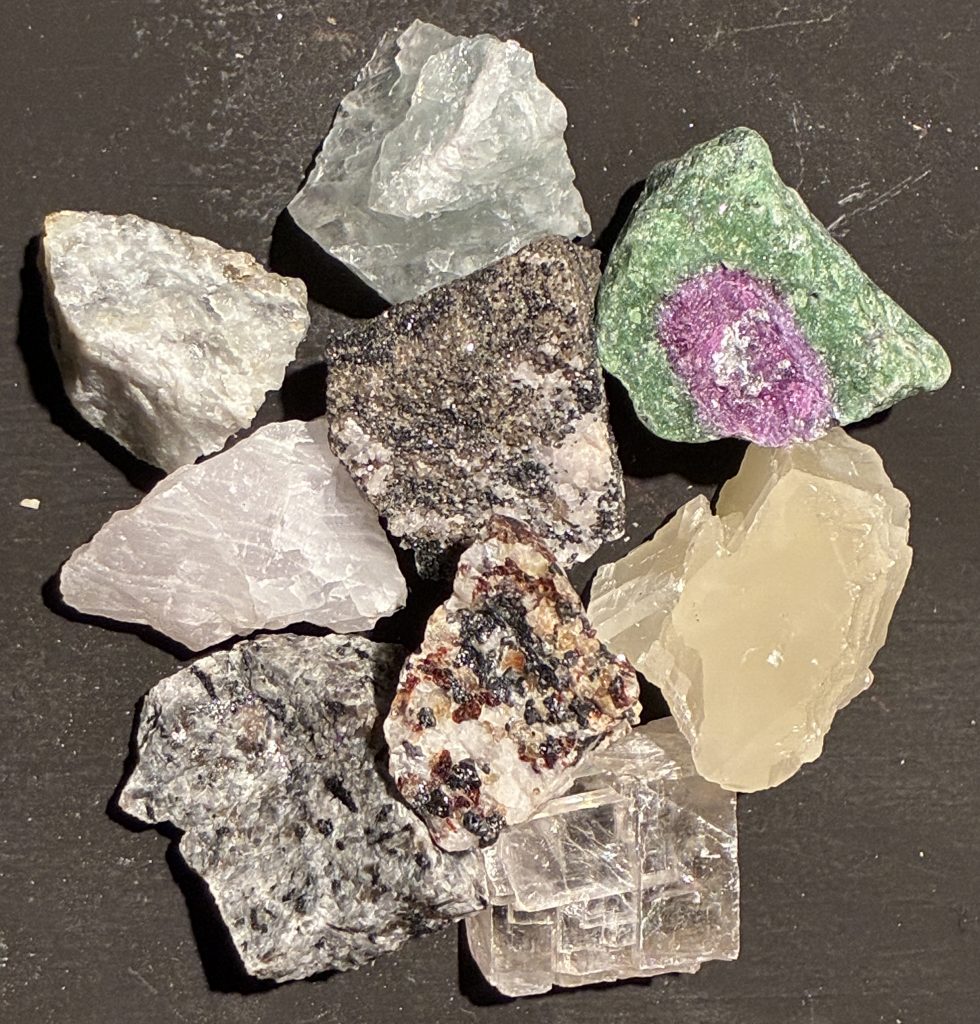
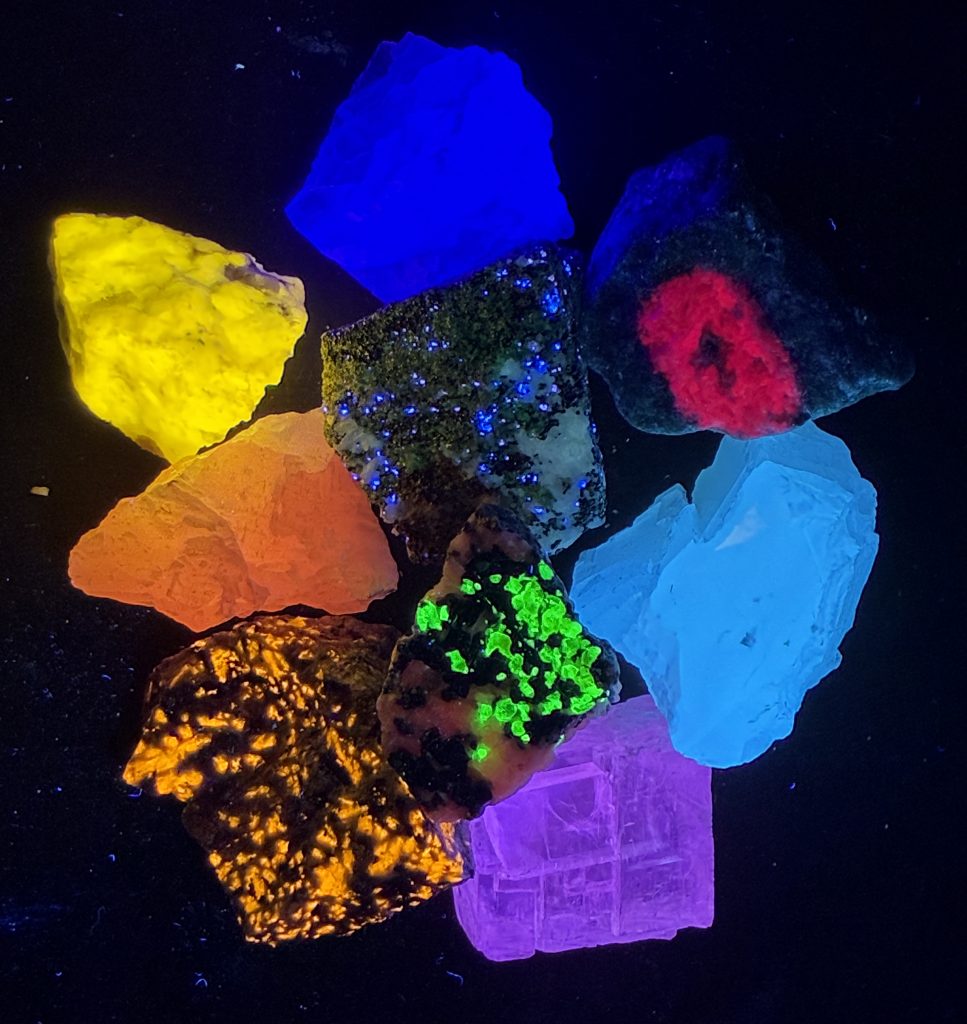
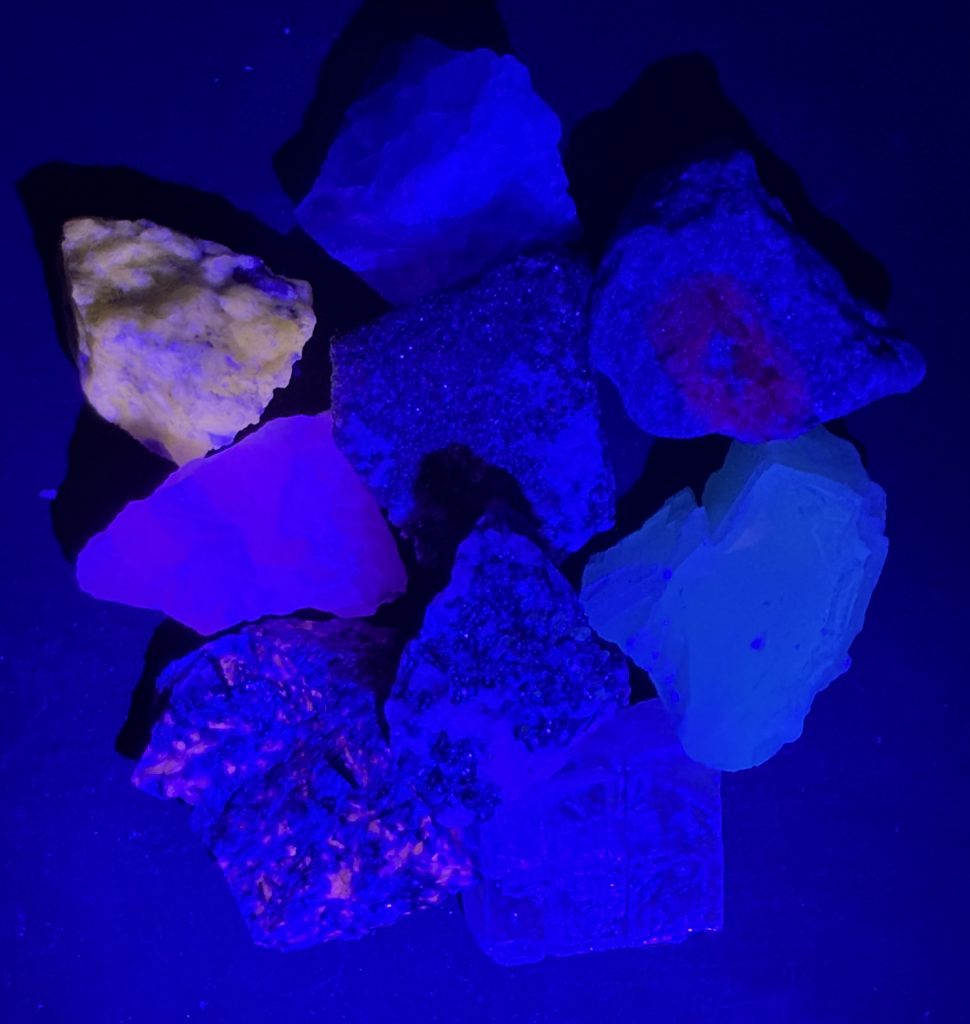
The filtered picture is beautiful. You can see why collecting and displaying fluorescent minerals can be an addictive hobby!
There are 9 little Long Wave UV rocks in the pictures. You can see the unfiltered UV torch is putting out a lot of blue which is almost completely overpowering the fluorescence of the minerals. The black background is non-fluorescent, but the visible light coming out of the unfiltered torch is lighting it.
Note: The filtered UV torch I used for the filtered photo was a wide beam UV torch. The unfiltered one was a narrow beam UV torch, hence the shadows in the unfiltered photo.
[The 9 Long Wave UV minerals are calcite, calcite rhomb, fluorite, manganocalcite, meionite (formerly wernerite), corundum (ruby), sphalerite, sodalite, willemite on calcite. Can you ID them? Click here for the answer.]
SO… Never buy an unfiltered torch!
ABOUT UV TORCH FILTERS
There are numerous types of UV filters. The main ones are Hoya U325C, the ZWB series, Dichroic filters. We (and most other sellers) use the ZWB series. Hoya and Dichroic torch filters are very expensive and would put our torches out of the reach of many people.
Both ZWB and Hoya filters have a limited life and eventually need replacing. The deterioration process is called “solarisation” and is more of a problem for SW and MW UV torch filters. There are claims that it may not affect LW use. The effect of solarisation is that eventually little or no UV can get through and fluorescence becomes weak, even for minerals that fluoresce brightly.
Both ZWB and Hoya are subject to “scunge” which, if not removed, will ruin the filter. (See next section)
CARING FOR THE FILTER
As well as normal cleaning dust etc from your filter, there are two problems you need to look out for.
1. Solarisation. It will happen, but not for years and you can’t stop it. See below for details.
2. “Scunge”. A white scunge can start to grow on SW and MW filters. If not cleaned off it will ruin the filter. The photo shows a ruined filter. You can help prevent scunge by storing the torch in a moisture-free place. If white scunge starts to appear, try to clean it off before it gets worse. If you can’t get it off you can use dilute phosphoric acid which will remove it. You can buy it from us ($5 + postage).

FREE FILTER REPLACEMENT
If your filter needs replacing for any reason (including accidental breakage) during the life of your torch (bought from us!) we will give you a replacement filter free of charge. Just send an email with your shipping details and torch model.
More About Solarisation of UV Torch Filters
Solarisation is a type of gradual degradation caused by UV radiation, leading to a decrease in UV transmittance over time. The UV torch filter’s performance deteriorates as it absorbs UV light rather than letting it through. Factors like the filter’s material, construction, and the intensity of the UV source contribute to the rate of solarisation.
The materials used to make the UV torch filter gradually absorb more and more of the ultraviolet light, and so cause a gradual change in their optical properties. The intensity of the UV light source is a key factor; filters exposed to high-intensity UV light will solarise more quickly.
So over time, as the UV light filter absorbs more and more of the UV, less and less UV light is left to come out and cause the fluorescence we want.
How to change the filter
The “ring” that holds the torch filter in place can be unscrewed. Remove it, install the new filter, and screw the assembly back on. Be careful to get the threads aligned properly. If the assembly doesn’t want to screw on, don’t try to force it. Keep trying until the threads align properly and screwing is easy and smooth. Tighten, but not too tight.
GO BACK or