Long Wave is 365nm. Short Wave is 254 or 255nm. Mid Wave is 310nm. [nm means “nanometer” which is the unit of measurement of the wave length of light. 1nm is one-billionth of a meter or one-millionth of a millimeter.]
Most people start with a Long Wave (LW) UV Torch. Long Wave torches and lamps are cheaper than Short Wave (SW) because LW LEDs have been around for a long time. They are highly developed and can be manufactured to be very bright. SW LEDs are only just emerging from their infancy. They are still expensive and not as bright as LW LEDs. However, they are getting better. Our recently launched FS12 torch starts a new era of SW fluorescence. It’s the first SW torch that is really powerful enough for field use.
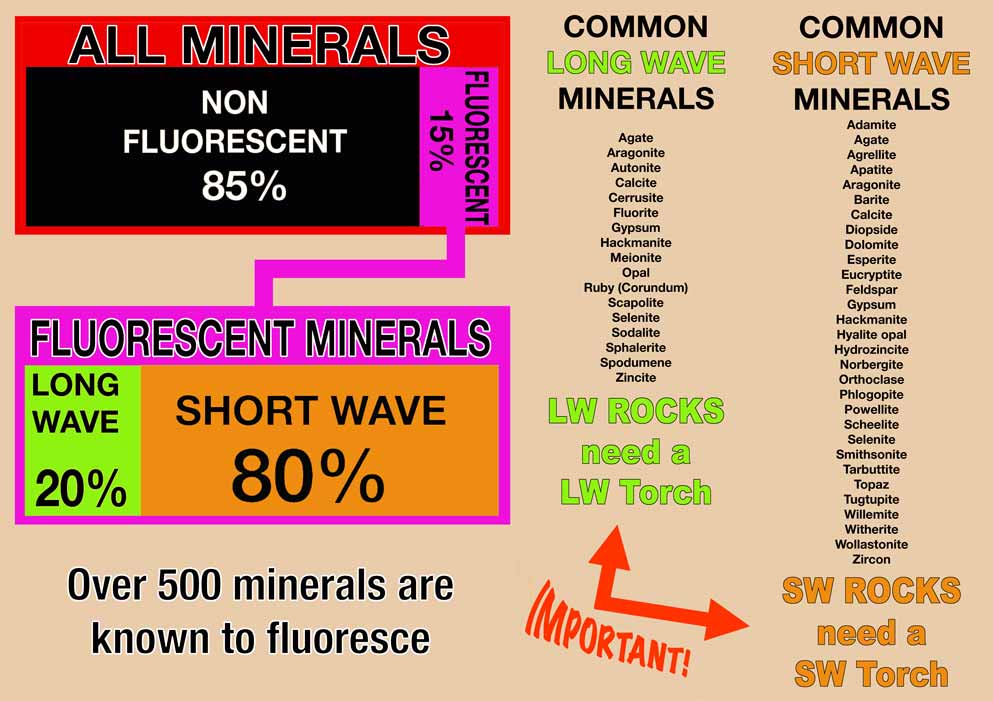
Only about 15% of all minerals fluoresce. Over 500 minerals are known to fluoresce. The problem is that only about 15-20% of them want LW and 80 – 85% want SW. Some are OK in SW or LW, but better in Mid Wave (MW) and vice versa. So if you want to find anything that’s there you should consider having both SW and LW.
That said, LW will find many of the common fluorescents – opal, calcite, fluorite, ruby, sphalerite, spodumene, sodalite etc.
Until recently my own collecting experience has been with “tube” SW lamps and LW LED torches. Tube SW lamps are expensive – see www.uvsystems.com or www.engeniousdesigns.com, (both friends of mine). FS12 is the first SW torch powerful enough to replace my uvsystems SW lamp.
Our FS26 26W SW lamp uses 240v, so if you want to use it in the field you would need a 12v battery and a 12v to 240v inverter.
If you are looking for a particular mineral you only need the wavelength it responds to. For example, if you are looking for opal or ruby or spodumene you only need LW. If you are after scheelite or willemite etc you only need SW.
One of the commonest minerals is calcite. Some calcites respond only to SW, others only to LW, others to both, and many are best in MW.
The chart above lists some common minerals and the wavelength they are best in.
SOME TIPS FROM AN OLD COLLECTOR …
A lot of nonsense is written by some UV torch sellers who obviously know nothing about mineral fluorescence. Some will sell you an unfiltered torch or even the wrong wavelength (like 395nm). My advice is based on many years of collecting and displaying.
So here are questions you need to answer:
• Are you wanting to find something specific – e.g. opal, scheelite, spodumene, ruby etc? Then you need to find out which wavelength you need. LW for opal, ruby etc; SW for scheelite etc. It’ no use looking for opal with a short wave torch or scheelite with a long wave torch – you won’t find any!
• Do you know what minerals are in the area you want to search in? Mindat.org (see below) can help you find out what might be there. Then you need to have the appropriate wavelength torch(es). See WHICH MINERALS FLUORESCE? below.
• Do you just want to go out and see what you can find? If you don’t have an idea of what’s there you really need both LW and SW. If you can only afford one, best to start with LW. It is cheaper, more powerful, and is great for non-mineral things that fluoresce like lichens, some plants, scorpions{!), possums, wombats etc.
• How serious are you? If you really don’t want to miss anything, you need the most powerful torch you can afford. Minerals (and even the same mineral) can differ greatly in how brightly they glow, so the more powerful your torch, the more likely you are to find weakly glowing specimens.
Not many minerals fluoresce only in MW. Some are best in MW but are OK in LW or SW (many calcites, agrellite, some apatites etc.) So for most people, MW comes well after their LW and SW torches.
WHERE TO LOOK
The best places to look for fluorescent minerals are old mining areas. They were mining there because minerals were there! There are also mineralised areas where mining has not occurred. The best way to find places to look for fluorescent minerals is Mindat.org.
HOW TO USE MINDAT.ORG
Go to www.mindat.org. In the Locality search box (at the bottom of every page) type an area, a place, a mine, a State etc. You will see a list of places and/or a map with circles containing numbers. On a map click the circle where your place of interest is and keep clicking until you come to the place you are looking for.
You will find a list of minerals found at the places you look for, but they don’t indicate which mineral or minerals in the list fluoresce.
WHICH MINERALS FLUORESCE?
When you have a list of minerals at a particular locality you’ll want to know which ones fluoresce and whether they want LW or SW. One of the most comprehensive lists of fluorescent minerals can be found at https:www.fluomin.org/uk/accueil.php. You can use this site to check if any of the minerals in your Mindat list are fluorescent, and whether you need LW or SW or both there. Another very comprehensive list is The Henkel Glossary of Fluorescent Minerals. You can buy it from https://www.uvsystems.com/products/87 or less expensively become a member of The Fluorescent Minerals Society and download it. And one more, perhaps the easiest to use: https://galleries.com/minerals/property/fluotabl.htm. But please remember, no list can be 100% accurate.
GO BACK or