

The brightness and colour of a given mineral’s fluorescence depends on the impurities in the mineral. Those impurities are called “activators”. Different activators in the same mineral can cause different colours of fluorescence. Too much or too little activator in a normally fluorescent mineral can cause it not to fluoresce at all, or to fluoresce only dimly.
Therefore, it is not possible to use fluorescence to definitively identify minerals, but it can help confirm an identification. For example, if you are looking for a mineral in an area where it is known or likely to exist, and you find the expected colour of fluorescence under the correct wavelength, there is a high probability that you have found what you are looking for.
GEOLOGISTS
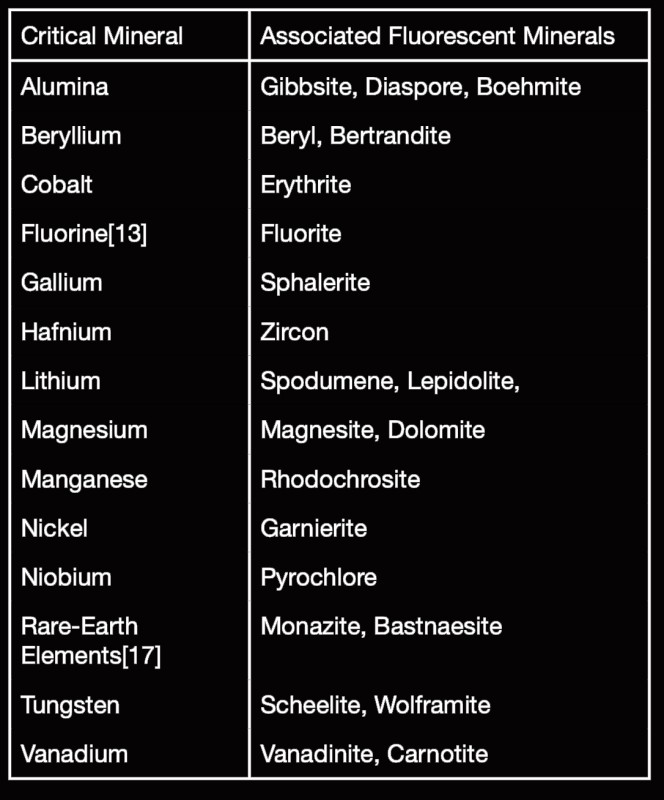
Every geologist, especially exploration geologists should have a LW and SW torch as part of their basic tool kit. Here’s a list of some critical minerals with associated minerals that fluoresce. [Fluorescence data from “The Henkel Glossary of Fluorescent Minerals”, Journal of the Fluorescent Mineral Soc., 1988). Data on the wavelength and colour of the fluorescence can be obtained from the Henkel Glossary or from www.fluomin.org.
LITHIUM
Lithium occurs in spodumene, lepidolite, petalite, eucryptite. Spodumene is the most common and important of these. To find Spodumene you need a Long Wave UV source. It usually fluoresces orange/tan/pink under Long Wave UV light, 365nm being the optimal wavelength. It can fluoresce other colours (rarely), as can Lepidolite and Petalite. Eucryptite fluoresces a deep cherry red under Short Wave UV.
[Long wave UV is also known as UVA and Short wave UV is also known as UVC]
Several of our powerful Long Wave 365nm torches are being used to find spodumene in Western Australia.
The video shows spodumene (18cm x 10cm) from a mine in WA fluorescing under an FL8 torch.
Initially the torch is about 3m from the rock, then about 2m and finally about 1m.
UPDATE: Fluorescence is much brighter under our new FL8A and FL20 365nm UV torches.
SCHEELITE & POWELLITE
Scheelite is the ore for Tungsten. In its pure form it glows bright white/bluish-white under SW UV. To find scheelite you need a Short Wave UV source. Scheelite does not glow at all under LW or MW. Any of our Short Wave torches can be used. Several mining and exploration companies have bought our FS12, and have reported great results. One company bought two FL12s to try, then ordered 11 more.
Scheelite and Powellite are closely related. Both can fluoresce under SW, but the color differs. Pure scheelite usually glows a bright bluish-white, while powellite typically glows creamy yellow. The fluorescence color of scheelite becomes more yellow as more molybdenum substitutes for tungsten in the crystal. So Scheelite can also fluoresce a yellowish colour.
RARE EARTHS
Quality UV torches are part of the toolbox of people searching for REEs (Rare Earth Elements). They can be used to find minerals that are known to contain, or to occur with, REEs. As well as the standard SW, MW and LW torches, other wavelengths such as 275nm and 340nm may be useful because some REEs or REE-containing minerals may fluoresce most brightly under “non-standard” wavelengths.
Some REEs fluoresce, some don’t. Rare Earths can occur in other minerals where they may act as “activators” which cause fluorescence. So good UV torches in a variety of wavelengths can find associated fluorescent minerals such as fluorites, calcites, apatites etc which may contain REEs.
GO BACK or